Cantilever Rack Systems in Columbus, OH
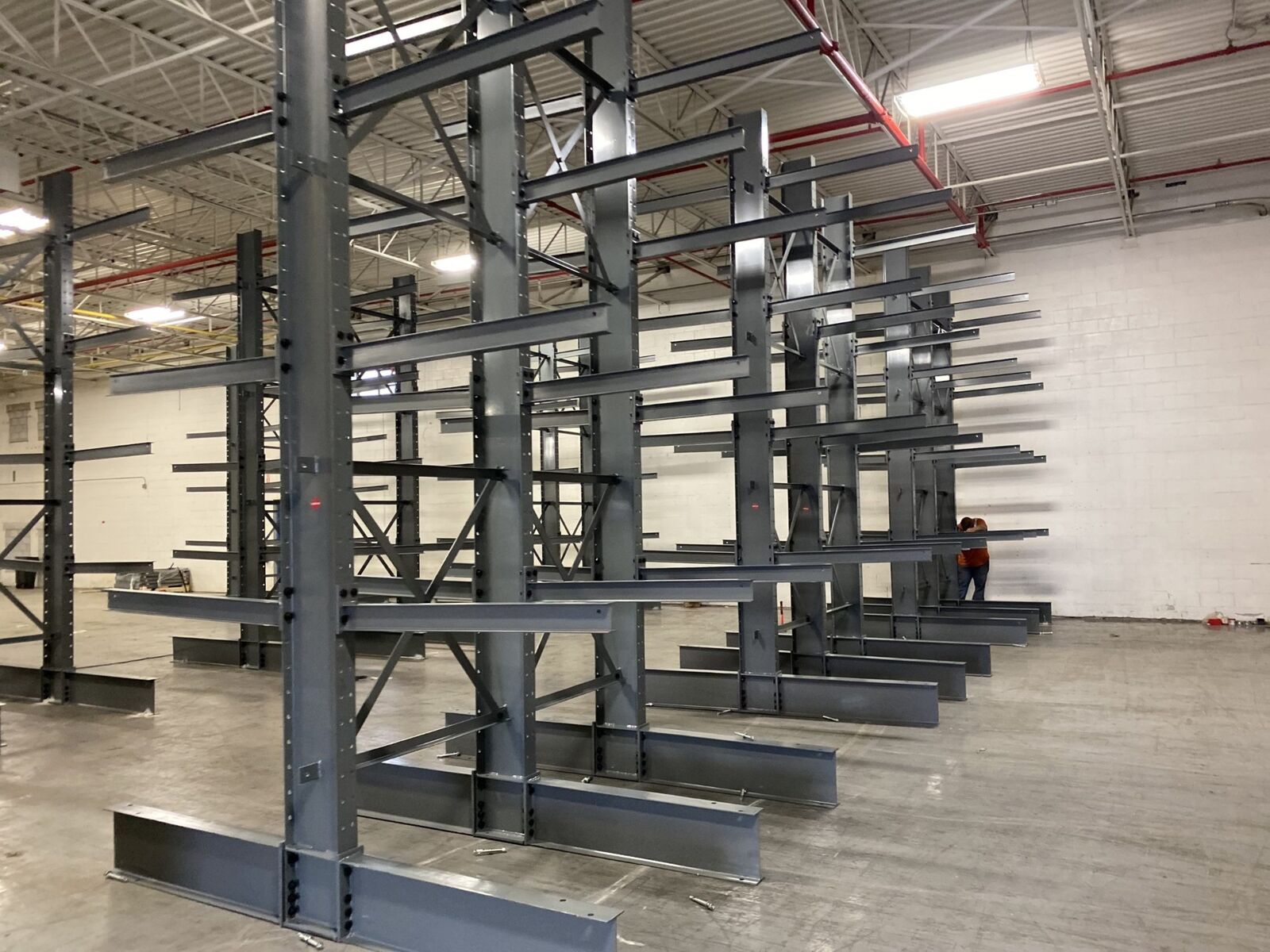
Cantilever rack exists because pallet rack has a front beam and long material doesn't care about pallets. Arms extend out from a column with no obstruction across the front, so lumber, pipe, tube, bar stock, sheet goods, and furniture load from the side and come off the same way, without lifting over anything.
Choose it whenever product length, not weight or SKU count, is what's driving the storage problem - the alternative is usually leaning bundles against a wall or floor-stacking them where forklifts have to work around them. Arm length, capacity, and column spacing get set by the bundles you actually handle, not a generic length.
For Columbus material handling operations, we quote single-sided runs for a wall and double-sided runs for open floor, both with the layout attached so arm count and levels are settled before steel is ordered.
How Cantilever Rack Works
Columns and anchored bases
Upright columns sit on bases anchored to the floor. Base depth is set by load and arm length so the run stays stable even under an off-center pick.
Arms at adjustable heights
Arms bolt or pin into the column at set increments and move as your product mix changes. Straight arms suit boxed goods; inclined arms with a lip hold round or loose stock in place.
Column spacing against sag
Spacing between columns is set so bundles don't sag between arms. A common starting rule places arms about half the load length apart, with the ends overhanging evenly.
Single-sided or double-sided
Single-sided runs go against a wall. Double-sided runs stand in open floor and load from both faces, doubling capacity per base without doubling the footprint.
Why Columbus Warehouses Work With Us
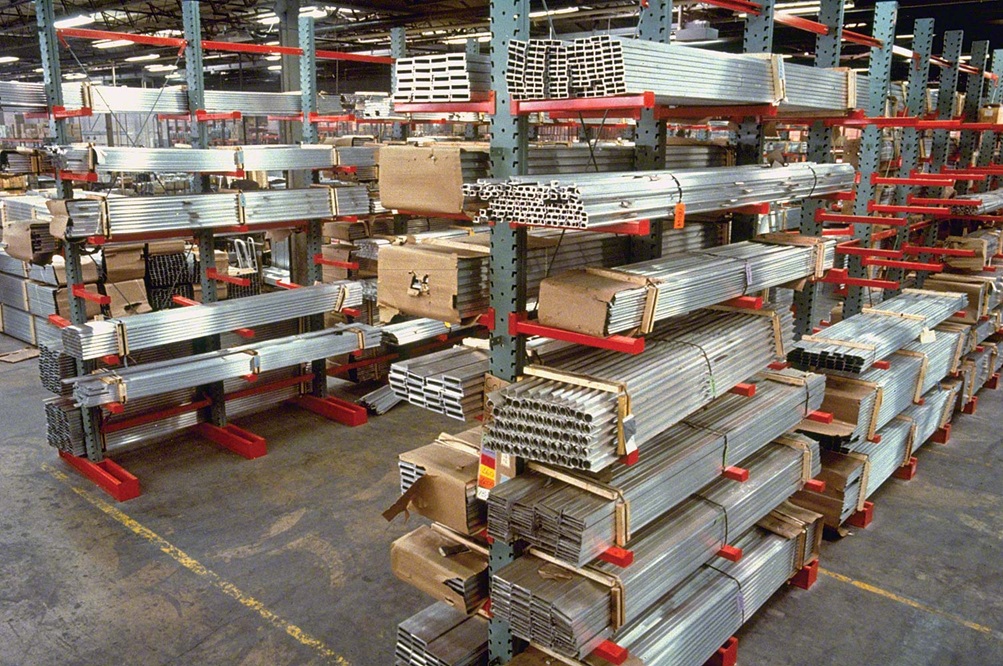
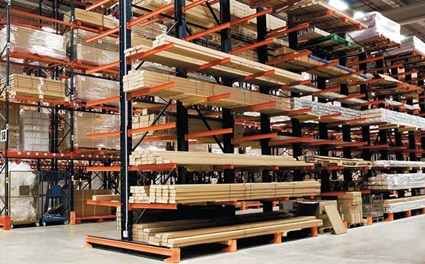
Building products, lumber, pipe, and bar stock move through a number of Columbus-area operations, particularly around the southwest industrial corridors and the light manufacturing accounts scattered through the I-270 loop, and cantilever rack is the system built for material that a pallet rack's front beam simply gets in the way of. Arms extend out from the column with nothing blocking the front, so long bundles load from the side and come off the same way instead of being leaned against a wall or floor-stacked where lift trucks have to work around them.
We set arm length, capacity, and column spacing from the bundles you actually handle - lumber and sheet goods call for straight arms, while pipe, tube, and conduit common to Columbus building products and distribution accounts usually need inclined arms with a lip to keep round stock from rolling forward. Column spacing gets checked against your heaviest bundle so material doesn't sag between arms, a detail that matters more once bundle lengths start varying across a single run.
Single-sided runs along a wall and double-sided runs in open floor both get drawn into the same CAD layout we use for the rest of the building, so a Columbus warehouse running cantilever along one wall and selective or pushback through the remainder has aisle widths and clearances that line up across the whole floor plan rather than being designed as two separate projects.
Where It Fits Best
What We Need to Design It
- What are the dimensions of the product being stored, length included?
- What's the typical weight per bundle?
- Straight arms or inclined arms - do you need lips to hold round stock?
- Single-sided along a wall, or double-sided in open floor?
- What's the clear height and the reach of your handling equipment?
What a Project Includes
Cantilever specification starts and ends with the load. We collect bundle dimensions, weight per bundle, and how material is handled - forklift forks, a side loader, or by hand off a cart - because that determines arm length, arm capacity, and how much clearance each level needs.
From there we set column height and spacing, choose straight or inclined arms, and decide whether lips are needed to keep round stock from rolling. Single-sided runs get positioned along a wall; double-sided runs get aisle dimensions matched to whatever's moving material in and out.
The quote itemizes columns, bases, arms, bracing, and anchors, with a CAD drawing showing the run, arm levels, and rated capacities per arm. Installation partners anchor bases, plumb columns, brace the run, and set arm elevations to the drawing.
The result is arms you can reposition as inventory changes, capacity ratings for every level, and the floor space that long material used to occupy.
Phone consultation
CAD layout
Itemized quote
Delivery & installation
Recent Installations
A sample of racking projects completed across the region.


Get a Cantilever Rack Quote
Send the basics and we will come back with a layout and pricing. Prefer to talk? Call 614-379-4436.
What's Included:
- Free warehouse consultation
- CAD layout drawings
- Itemized project quote
- Rack type recommendations
- Installation timeline
Cantilever Rack Questions for Columbus
Cantilever Rack by Service Area
Delivery and installation across Central Ohio.
Other Rack Systems We Supply
Pallet Rack
Every pallet reachable, every time. The baseline we size everything else against.
Pushback Rack
Two to six pallets deep from one aisle, without giving up much reach.
Pallet Flow Rack
Load one side, pick the other, and let gravity enforce first in, first out.
Drive-In Rack
Storage lanes replace internal access aisles. Forklifts enter the structure to handle bulk pallets.
Carton Flow Rack
Cases advance to the picker instead of the picker hunting for cases.
Warehouse Relocation
Moving buildings without losing the racking plan that already works for your operation.
Where We Work
Located in Columbus, we serve the entire Greater Columbus region with industrial pallet racks and warehouse storage solutions.
Columbus Pallet Rack
Address
4551 Wright Ave.
Unit #2092
Columbus, OH 43213
Phone
614-379-4436Business Hours
Monday - Friday: 8:00 AM - 6:00 PM
Saturday: Closed
Sunday: Closed
Ready to Price Cantilever Rack?
Call 614-379-4436 or request a quote and we will start a layout.